THE SCIENCE BIT
Why you can know exactly what to do, and still not do it.
A hundred years of research, and one ordinary Tuesday.
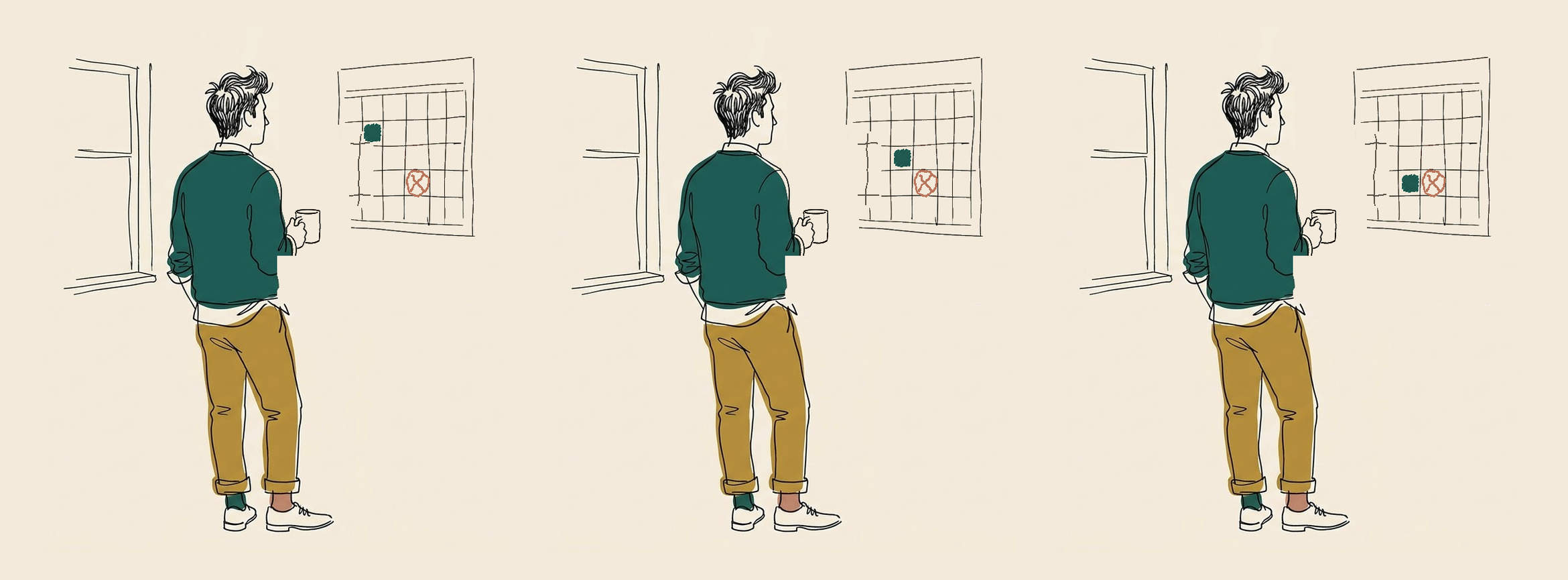
six weeks out
three weeks out
this week
One Tuesday
Sam and the passport
It's a Tuesday in April, and Sam knows exactly what to do about the passport.He knows the trip is in July. He knows the passport expired in February. He knows renewals take a few weeks and you're meant to allow longer in summer. He knows the form is online, that it takes twenty minutes, and that the photo booth is in the supermarket he goes to anyway.
If you stopped him in the street and asked, he'd tell you in one clear sentence, faster than most people.
He does not renew the passport.
Not because he forgets; he thinks about it most days, usually around eleven at night. Not because he doesn't care; the trip is the thing he's most looking forward to all year. Not because it's hard. He has done harder things that morning.
He thinks about it on Tuesday, and Wednesday, and the Tuesday after. Each time, July is a rumour. It has no weight. The knowledge sits there, complete and correct and entirely inert, and the twenty minutes never arrives.
In June, the trip stops being a rumour and becomes a fact, and Sam renews the passport in a single afternoon of expensive panic: courier fees, an emergency appointment, a two-hour round trip. He does it flawlessly. He was always able to do it flawlessly.
Afterwards someone says: you knew about this in February.
And he did. That was never the problem.
What the research says
A gap between knowing and doing
In 1997 Russell Barkley pulled the scattered findings together into one argument: ADHD isn't a shortage of attention or of knowledge. It's a difficulty with self-regulation, with doing what you already know, at the moment it counts.
He called it a disorder of performance, not knowledge. Draw it and you get two lines.
This is why most productivity advice slides off. Almost all of it delivers information to the top line, you should renew your passport, to people who already have it, in high definition, at eleven o'clock at night.
the advice was never the missing piece.
Pillar one
The future doesn't pull
Barkley's account puts time at the centre. The executive system exists to let us act toward things that haven't happened yet. When it's impaired, consequences that aren't close simply don't exert much force.
It isn't that Sam can't read a calendar. It's that April's version of July weighs almost nothing.
Pillar two
Starting is the expensive part
Sam's form took twenty minutes. The twenty minutes were never the cost. The cost was all in the crossing, the step from intending to doing, which clinicians call initiation and Thomas Brown puts at the front of his six-cluster model as activation.
Here's the part that explains a lot of ordinary life: initiation is charged per task, not per minute. One hard job costs one start. Twenty small jobs cost twenty.
And a failure to start produces nothing to look at. Nothing happened. From outside it's indistinguishable from not caring, which is where a hundred years of lazy comes from, and why it's so hard to argue with.
you can't show anyone the thing you didn't do.
Everyone is somewhere
Three dials, not one switch
ADHD isn't one quantity with a low end and a high end. Twin and genetic studies point to traits spread continuously through the whole population, with no natural gap between people who have it and people who don't.
Three dimensions matter, and they move semi-independently. Everyone sits somewhere on each.
Attention
Holding, shifting and releasing focus on purpose, including the difficulty of stopping once you've started.
in the diagnosisThe pause
The beat between impulse and action. Restlessness, interrupting, deciding faster than you meant to.
in the diagnosisFeeling
How fast an emotion arrives and how long it takes to come down. Argued to be core, but not part of the formal criteria.
contestedTwo things follow that are easy to miss.
The dashed line is drawn by us, not by nature. It sits where difficulty becomes impairment, and impairment depends on what your life demands of you. Move someone into a job with no deadlines and the same person crosses back.
The dials aren't independent, and people sit at different points on each. That's why two people with the same diagnosis can look nothing alike, and why one tool can be transformative for one of them and useless for the other.
"everyone's a bit like that"? yes. everyone's a bit tall, too.
some people still can't reach the shelf.
A hundred years
The boy who couldn't sit still
For most of the last century, the definition was the disruptive schoolboy. Watching that dissolve explains why so many adults are only recognising themselves now.
- 1902George Still describes children with, in his phrase, a defect of moral control. The vocabulary of character arrives a century before the vocabulary of mechanism.
- 1920sChildren left restless and disinhibited after the encephalitis epidemic anchor the idea that this is brain damage. It becomes "minimal brain dysfunction" once no damage can be found.
- 1968The DSM names it Hyperkinetic Reaction of Childhood. Movement is the disorder. If you weren't visibly moving, you didn't have it.
- 1972Virginia Douglas argues from her data that the core problem isn't excess movement at all; it's sustained attention and impulse control. Hyperactivity is a symptom, and one that fades.
- 1980DSM-III renames it Attention Deficit Disorder and makes hyperactivity optional. In one revision the restless boy stops being the definition and becomes one presentation of it.
- 1994DSM-IV formalises a predominantly inattentive presentation. The quiet version finally has a name.
- 1997Barkley's unifying theory moves the centre again: not attention, not movement, but self-regulation across time.
- 2013DSM-5 raises the age-of-onset threshold, lowers the symptom count for adults, and allows diagnosis alongside autism. Adulthood is no longer the end of it.
The cost of those eighty years was borne by anyone whose difficulty was invisible. The gateway to assessment was disruption to other people, so children who were internally chaotic but outwardly quiet weren't misdiagnosed. They were never assessed. They were called dreamy, disorganised, not applying themselves.
That is the direct cause of the thing happening now: adults, disproportionately women, recognising themselves decades late, usually when their own child is assessed, or when a description finally matches the inside rather than the outside.
the name we still use describes the least essential part.
an adhdmind hypothesis, not a research finding
Why now
The work that got handed to you
Something changed, and it wasn't people. Ruth Schwartz Cowan showed in 1983 that a century of household technology didn't reduce domestic labour: it removed other people's share and raised the standards to fill the gap. Ivan Illich gave the leftover a name, shadow work: unpaid labour that the economy requires and never counts.
Then the intermediaries went. The travel agent, the insurance broker, the bank clerk, the switchboard, the secretary. Each was a piece of executive function held outside your head and available to anyone. They weren't replaced. You were promoted into the role, unpaid, untrained, and without being asked.
Nobody designed this, and nobody is counting it. But if initiation is the scarce resource, then a world that quietly multiplied the number of starts has raised the cost of ordinary participation, most of all for the people with least to spare.
the world could be kinder about this than it is.
it also isn't going to change by july.
What we do about it
Small hands, at the right moment
Barkley's own practical prescription runs through everything above, and it isn't try harder or learn a system. It's this: put the information outside your head, at the point of performance, visible in the moment and place where the action has to happen.
That's the whole design brief. Not more information. Less carrying.
Catching costs nothing
One tap, no fields, no decisions. If capture has a cost, the thought doesn't get caught. And the moment it arrives is always the wrong moment to decide anything.
Sorting happens later
Deciding where something goes is a separate job from noticing it. Do it when you can think, and it lands where you'll actually look.
Weeks, not "someday"
A calendar in real weeks with a plain distance marker: in 6 days. Not to tell you something new. To make the distant thing present enough to act on while acting is still cheap.
Some things wait for a moment, not a date
A list called in town or at my laptop is a scene, not a category. It's waiting where you'll be, which is the closest thing to a cue that doesn't nag.
Quiet by default
A nudge or a shout, your call, per item. Insistence you didn't choose is just another demand, and demands are the thing there's least of.
Nothing to maintain
No accounts, no passwords to forget, no integrations pushing at you. A system that needs upkeep is one more thing to start.
None of this is a treatment, and none of it changes the shape of anyone's dials. It moves a few things out of your head and puts them where you'll be standing when you need them.
less to carry. more room to live.
Being straight with you
What we're not saying
A page like this is only worth reading if it tells you where it's thin. So:
- Executive function difficulties are not universal in ADHD. Willcutt's meta-analysis found them real but moderate, and present in a minority-to-half of people diagnosed. Anyone claiming ADHD simply is broken executive function is overstating it.
- There is no single deficit. Joel Nigg and others have argued at length that ADHD is heterogeneous, with several routes to a similar presentation. The tidy single-cause story is a simplification, including ours.
- Rejection sensitive dysphoria is a clinical description, not a validated construct. It's widely felt and widely repeated, but it isn't established in the peer-reviewed literature the way emotion dysregulation is. We use it because people recognise it, not because it's settled.
- We've kept the brain chemistry light on purpose. Dopamine signalling in the reward pathway is the best-supported mechanism, but neurochemical stories have a poor record of surviving better methods; the serotonin theory of depression is the cautionary tale. "The future doesn't produce a strong enough signal" will still be true in twenty years. "Your dopamine is low" might not be.
- The modern-life argument is ours, not a finding. Shadow work, administrative burden and rising returns to non-cognitive skill are all real literatures. Joining them into "ordinary life now demands more executive function than it used to" is our inference, and nobody has measured it directly.
- None of this is diagnostic, and none of it is treatment. For diagnosed ADHD, medication has stronger evidence than anything on this page. If you think this describes you, that's a conversation worth having with a doctor.
Built from all of this
Catch it anywhere. Sort it later. Find it when you need it.
See the toolsOr take the quiz. It's a self-reflection tool, not a screening test, and it will happily tell you these apps aren't for you.
Sources
Where this comes from
no jargon. no cures. sources at the bottom.
- Barkley, R. A. (1997). Behavioral inhibition, sustained attention, and executive functions: constructing a unifying theory of ADHD. Psychological Bulletin, 121(1), 65–94.
- Barkley, R. A. (1997). ADHD and the Nature of Self-Control. Guilford Press.
- Willcutt, E. G., et al. (2005). Validity of the executive function theory of ADHD: a meta-analytic review. Biological Psychiatry, 57(11), 1336–1346.
- Sonuga-Barke, E. J. S. (2003). The dual pathway model of AD/HD. Neuroscience & Biobehavioral Reviews, 27(7), 593–604.
- Sonuga-Barke, E. J. S., & Castellanos, F. X. (2007). Spontaneous attentional fluctuations in impaired states: a neurobiological hypothesis. Neuroscience & Biobehavioral Reviews, 31(7), 977–986.
- Shaw, P., et al. (2014). Emotion dysregulation in attention deficit hyperactivity disorder. American Journal of Psychiatry, 171(3), 276–293.
- Brown, T. E. Six-cluster model of executive function impairment in ADHD.
- Douglas, V. I. (1972). Stop, look and listen: the problem of sustained attention and impulse control. Canadian Journal of Behavioural Science, 4(4).
- Still, G. F. (1902). The Goulstonian Lectures on some abnormal psychical conditions in children. The Lancet.
- Gollwitzer, P. M., & Sheeran, P. (2006). Implementation intentions and goal achievement: a meta-analysis of effects and processes. Advances in Experimental Social Psychology, 38, 69–119.
- Cowan, R. S. (1983). More Work for Mother. Basic Books.
- Illich, I. (1981). Shadow Work. Marion Boyars.
- Edin, P.-A., et al. The rising return to non-cognitive skill. IZA Discussion Paper 10914.
- Jackson, J. N. S., & MacKillop, J. (2016). Attention-deficit/hyperactivity disorder and monetary delay discounting: a meta-analysis of case-control studies. Biological Psychiatry: Cognitive Neuroscience and Neuroimaging, 1(4), 316–325.
- Faraone, S. V., et al. (2021). The World Federation of ADHD International Consensus Statement: 208 evidence-based conclusions about the disorder. Neuroscience & Biobehavioral Reviews, 128, 789–818.
- Marx, I., et al. (2021). ADHD and the choice of small immediate over larger delayed rewards. Journal of Attention Disorders, 25(2), 171–187.
- Kofler, M. J., et al. (2013). Reaction time variability in ADHD: a meta-analytic review of 319 studies. Clinical Psychology Review, 33(6), 795–811.
Every claim above has been checked against the source. If you think we've stretched one, tell us at [email protected] and we'll fix it.